




:: Now begins a story...
May I present to you, a finely curated section of a fine collection of the wonderful web we weave with a weekly roundup of bits and pieces from the far corners of the super information highway that I like to call — Token Wisdom ✨


"It is not the voice that commands the story; it is the first image."
— Italo Calvino

Editor's Notes 📆
Week 11 of 52 // March 8th 🧿 14th, 2026
This week's thread is attention: who builds it, who owns it, who depletes it, and who profits from the gap between the state you're in and the state a deliberating person would need to be. The essay this week is about pre-suasion — the architecture of influence that precedes the argument and determines how it lands.
The common thread: the substrate precedes the content. The room is set before you walk in. And most of what we call reasoning is post-hoc navigation of an environment we did not design and rarely examine.
Where the future arrives before we understand the present... becomes a gift 🎁

🔮 Pearls of Wisdom, The Latest Edition...
Get smart, fast. If you're pressed for time and want to keep up to date!
Enjoy The Newest Latest, A Closer Look & Time Well Spent!
🎉 Newest / Latest
100% Authentic Humanly Chosen
The Attention Audit: When the Persuasion Was Never the Point
This week's collection maps the infrastructure of influence at every layer — neural, orbital, hydraulic, and computational. The brain issues error signals that look like machine learning. Canada's satellite dependency turns out to be a sovereignty question. AI data centers are drinking the water table. And a framework for mapping AI memory geometrically suggests that the tools we use to extend cognition have structure most users never see. The room is always already set. The only question is who set it and why.
- Neurons Receive Precisely Tailored Teaching Signals as We Learn
MIT neuroscientists found that the brain delivers specific, targeted feedback during learning — error signals that closely resemble the correction mechanisms driving machine learning systems. The implications for how we think about learning, AI training, and the interface between the two are not subtle. Read more at MIT News - Data Center Cooling Could Drive $10 Billion to $58 Billion in New Waterworks
A UC Riverside and Caltech study posted to arXiv finds that US community water systems will need billions in new infrastructure to meet the peak cooling demands of AI and cloud data centers. This is the physical invoice for ambient AI. It lands on municipal water budgets, not on the companies generating the demand. More at TechXplore - Canada Takes Its Sovereignty Push to Space
Canada is expanding domestic satellite infrastructure and reducing dependence on Starlink. This is not primarily a technology story. It is a calculation that communications infrastructure controlled by a foreign private entity is a sovereignty liability — one that became impossible to ignore once the entity's owner became a US government figure with explicit foreign policy positions. Read more at The New York Times - The Intelligence Manifold: Applying Geometric Principles to Memory Systems
An analysis of overlapping AI memory architectures — Mem0, Hindsight, Letta, Cortex, Graphiti, Cognee — finds that geometric principles can map the structural relationships between them more usefully than feature comparison tables. Its value is in making visible the shape of a space most practitioners navigate by feel. More at Medium - How Switzerland Could Shape the Chip Industry's Power Balance
Switzerland's RISC-V ecosystem is positioning the country as a neutral infrastructure node in a semiconductor landscape increasingly defined by national champions and export controls. The bet is that open architecture outlasts proprietary dominance in the long run, the same way TCP/IP outlasted every competing network protocol. Read more at SWI Swissinfo - The Goldilocks Zone
Packy McCormick's argument: AI is oil, not God. Useful, transformative, extractable, spill-prone, and subject to the same boom-bust infrastructure economics as every prior energy transition. Not omnipotent. Not existential. Not magical. More at Not Boring - Rebuilding Confidence: Why Canada Must Fix Its Capital Formation Gap
John Ruffolo's argument: Canada's innovation problem is not a talent problem or an ambition problem. It is a capital formation problem. The satellite sovereignty story and this story are the same story told from different altitudes. Read more at Substack - Pi Day: Breakthrough Obliterates the World Record for Calculating Pi
The number was calculated π to 314 trillion digits, setting a new world record on Pi Day. The practical applications are zero. The value is entirely in what it demonstrates about storage throughput, computational endurance, and the engineering culture that treats a transcendental number as a benchmark. More at ScienceAlert - What Is a Galaxy? That's a Surprisingly Difficult Question to Answer
The definition of a galaxy is genuinely contested, and getting it right matters for dark matter models, cosmological structure formation, and potentially particle physics. Classification problems in science are often load-bearing — the definition determines what gets measured, and what gets measured determines what gets understood. Read more at New Scientist - How to Find Pi in Randomness All Around You
Random coin flips, Buffon's needle, and the geometry of chance all converge on π in ways that have no obvious reason to work. This is either deeply reassuring about the coherence of mathematics or deeply unsettling about the nature of randomness. Possibly both. More at Scientific American
👁️ A Closer Look
Unearthing gems in the digital landscape.
Because in the ever-evolving tech world, there's always more to learn and laugh about.
The Room Was Already Set Before You Walked In
A 2016 study in the Journal of Consumer Psychology matched the Facebook Likes of 3.5 million users to real purchasing behavior and found that psychographic micro-targeting outperformed demographic targeting in predicting what people would actually buy. The mechanism wasn't better persuasion. It was better sequencing — delivering the message into a pre-characterized attentional state.
Before the argument opens its mouth, the room has already decided how it will be received…
 🌶️ iamkhayyam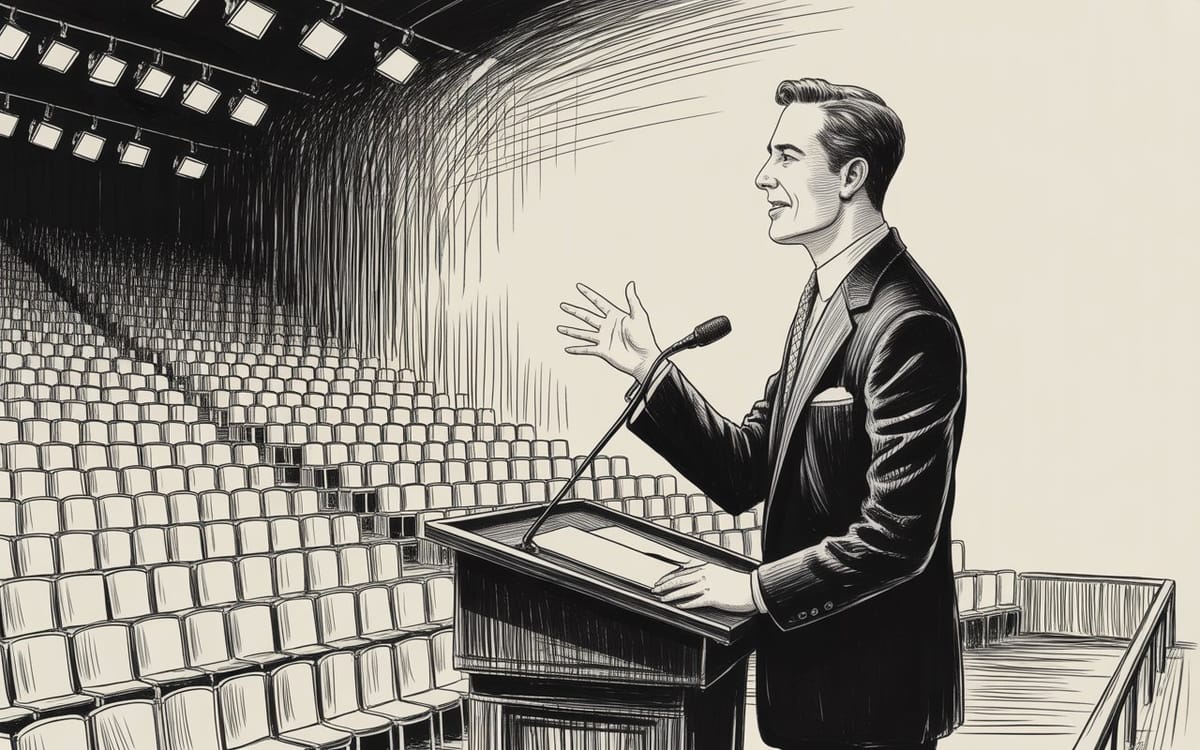
"The persuasion is the last nail. Pre-suasion is the house. And someone else already built it."
— From The Room Was Already Set Before You Walked In → [link]


A Closer Look: Explorations in Technology
Weekly essay in the areas of blockchain, artificial intelligence, extended reality, quantum computing, and all the bits and pieces.

A Closer Look: Explorations in Technology
Weekly essay in the areas of blockchain, artificial intelligence, extended reality, quantum computing, and all the bits and pieces.

📺 Time Well Spent
Top Ten of the Time I Spend
The Substrate Beneath the Signal
This week's selections pull toward the foundational and the uncomfortable. A deception so gradual it felt like weather. A paradox that exposes the limits of rational choice theory. A defense contractor most people can't describe. An AI that its own engineers can't fully characterize. A ten-year-old who beat the professionals by caring more. And an economic treaty from 1985 that may be the template for what's happening to a different economy right now.
- The Greatest Deception of Our Time Is Happening Right Now
Something has felt off. The rhythm of daily life changed and nobody announced it. This video names the feeling and traces it to its source — the ambient, gradual, unannounced shift in how attention is structured, monetized, and consumed. It is not alarmist. It is descriptive. Watch on YouTube - Why Does TIME Stop For Light? — Feynman's Mind-Bending Discovery
A photon leaving a distant star experiences zero time between emission and absorption, regardless of how many billion years pass for the observer. The implication — that duration is observer-dependent at the most fundamental level — is one of those physics results that sounds metaphorical until you realize it's just true. Watch on YouTube - Impossible Ancient Machines — Engineering That Modern Technology Still Can't Recreate
Precision stonework, structural tolerances, and material properties in ancient construction that remain unexplained by the tools we assume were available. The honest version of this topic is not "ancient aliens" — it is "our model of what ancient humans were capable of is probably wrong, and we don't know in which direction." Watch on YouTube - This Paradox Splits Smart People 50/50
Newcomb's Paradox: a predictor with a near-perfect track record presents two boxes. One contains $1,000. The other contains $1,000,000 if the predictor predicted you'd take only that box, or nothing if it predicted you'd take both. Neither camp has closed the argument in fifty years. The paradox is not a trick. It is a genuine fault line in decision theory. Watch on YouTube - The AI Book That's Freaking Out National Security Advisors
If we build something vastly smarter than us, what happens next? The 80,000 Hours treatment of the superintelligence alignment question, grounded in the literature that is actually circulating in policy circles rather than in the popular discourse that tends to be two years behind it. Watch on YouTube - Why People Are Throwing AI Data Centers Into the Ocean
Every ChatGPT query consumes water and electricity. Engineers are experimenting with underwater data centers to address heat dissipation and energy costs. Microsoft's Project Natick ran for two years on the seafloor off Scotland. The results were surprising in both directions. The failure rate was lower than land-based equivalents. Watch on YouTube - What Does Anduril Actually Do?
Most people who have heard of Anduril cannot accurately describe what it builds, who it sells to, or why it matters. This video fixes that. It is one of the most consequential companies in the current defense procurement transformation — and one of the least understood by the general technology audience. Watch on YouTube - AI Is Mutating: And We Don't Know What It Is Doing
The engineers building AI don't fully understand how it works. This is documented, not speculative. The broader argument is that AI is not a tool being operated by humans so much as a process unfolding through humans, and the distinction matters more than most deployment frameworks acknowledge. Watch on YouTube - Genius 10-Year-Old's Research Shocks Scientists Around the World
Jo Nagai raised and trained swallowtail caterpillars at different altitudes and produced results that field biologists hadn't seen and couldn't immediately replicate. He succeeded because he had continuous, intimate access to his subjects — the kind of access that professional researchers optimizing for publication throughput rarely maintain. . Watch on YouTube - The Secret 1985 Deal That Destroyed Japan — And Is Being Repeated Right Now
Five men at the Plaza Hotel signed an agreement that restructured global currency values and quietly dismantled the world's second-largest economy over the following decade. Japan never fully recovered. The video's argument is that the structural conditions that made the Plaza Accord possible — and devastating — are present again, applied to a different economy. Watch on YouTube

✨Token Wisdom
Knowledge Transmuted
In this edition, we traced the layer beneath the content. The brain teaches itself with error signals that mirror machine learning — which raises the question of what happens when an external system learns to exploit that loop before the brain knows it's running. Canada decided its satellite dependency was a sovereignty problem. AI's water appetite made the cost of cognitive infrastructure concrete and municipal.
A ten-year-old outran professional biologists by refusing to optimize for anything except closeness to the problem. And an essay argued that the most consequential influence infrastructure in human history operates without critics, regulators, or a reputation problem — because its primary operating condition is invisibility. The room was already set. The argument was always the last thing.
🌈💫 The Less You Know
The More You Learn
Latest Technologies & Innovations
- Pre-Suasion Architecture: The systematic preparation of psychological states prior to persuasive messaging; operates upstream of deliberative cognition and downstream of platform engagement design
- Precision Neural Teaching Signals: The brain's mechanism for delivering targeted error-correction feedback during learning, functionally parallel to backpropagation in machine learning systems
- RISC-V: An open-source instruction set architecture for chip design, enabling hardware development outside the proprietary ecosystems controlled by Intel, ARM, and their licensees
- Intelligence Manifold: A geometric framework for mapping AI memory systems by their structural relationships rather than their surface feature sets
- Newcomb's Paradox: A decision theory problem in which dominance reasoning and expected value reasoning yield opposite recommendations, with no consensus resolution after fifty years of philosophical attention
- Underwater Data Centers: Server infrastructure deployed on the ocean floor for passive cooling; Microsoft's Project Natick demonstrated lower failure rates than equivalent land-based systems
Most Important Topics
- The Substrate Question: Whether Canada's satellite dependency, AI's water consumption, and platform pre-suasion are three instances of the same problem — control of the infrastructure beneath the content
- Neural-AI Learning Parallels: What MIT's error-signal finding means for the interface between biological and artificial learning systems
- The Capital Formation Gap: Why Canada's innovation output consistently gets commercialized elsewhere, and whether the satellite sovereignty move signals a shift in how the country thinks about strategic infrastructure
- Newcomb's Decision Theory Fault Line: Why a fifty-year-old paradox still has no consensus and what that reveals about the foundations of rational choice
- AI Mutation and Interpretability: The documented gap between AI capability and AI comprehension — and why "we don't fully understand it" is an engineering statement, not a metaphor
- The Plaza Accord Pattern: Whether the 1985 currency restructuring that preceded Japan's lost decades is a template being applied again
Acronyms
- RISC-V — Reduced Instruction Set Computer, version 5: open-source chip architecture
- MIT — Massachusetts Institute of Technology
- arXiv — Open-access preprint server for scientific research (pronounced "archive")
Technical Terms
- Psychographic Targeting: Audience segmentation based on psychological and behavioral characteristics rather than demographic variables; demonstrated in the Matz et al. 2016 study to outperform demographic targeting in predicting purchasing behavior
- Error Signal (Neural): Targeted feedback delivered to specific neurons during learning that drives parameter updates; MIT's 2026 finding shows these are more precise and localized than previously understood
- Backpropagation: The algorithm by which neural networks adjust weights during training by propagating error signals backward through the network; the MIT finding suggests biological learning uses a functionally similar mechanism
- Dominance Reasoning: In decision theory, choosing an option that is at least as good as alternatives in all scenarios and better in at least one; in Newcomb's Paradox, dominance reasoning recommends two-boxing
- Expected Value Reasoning: Choosing the option with the highest probability-weighted outcome; in Newcomb's Paradox, expected value reasoning recommends one-boxing
- Tacit Knowledge: Expertise embedded in practice that precedes and resists verbal articulation; this week's ten-year-old produced results professionals couldn't because tacit proximity to subjects is not transferable through methodology sections
Just because Jon Snow knows nothing, doesn’t mean you have to.
Embrace the pursuit of knowledge to shape a better tomorrow. Sign up for more Token Wisdom and carry the torch of foresight into the fathomless domains of innovation and beyond.
"The platform doesn't persuade you. It manufactures the state in which persuasion no longer has to try. You walked into a room that was already set. You just didn't see the furniture."
— Token Wisdom on the architecture that replaced the argument ✨
Until next time: stay smart, and kind, and definitely stay weird!
🔮 Token Wisdom · 151st Edition · Week 11 of 52 · March 8–15, 2026
Become a Token Wisdom subscriber
Illuminate your inbox with the light of knowledge. ✨
Thank you for cruising by the Cult of Innovation
We’re making some Stone Soup here. If you enjoyed this amuse-bouche of news compilations in bite-sized morsels, please share it with your friends and help feed a community. Mmmm. #nomnom.
Don't forget to check out our 2025 Rollup the Rim to Win Token Wisdom =)
 🌶️ iamkhayyam